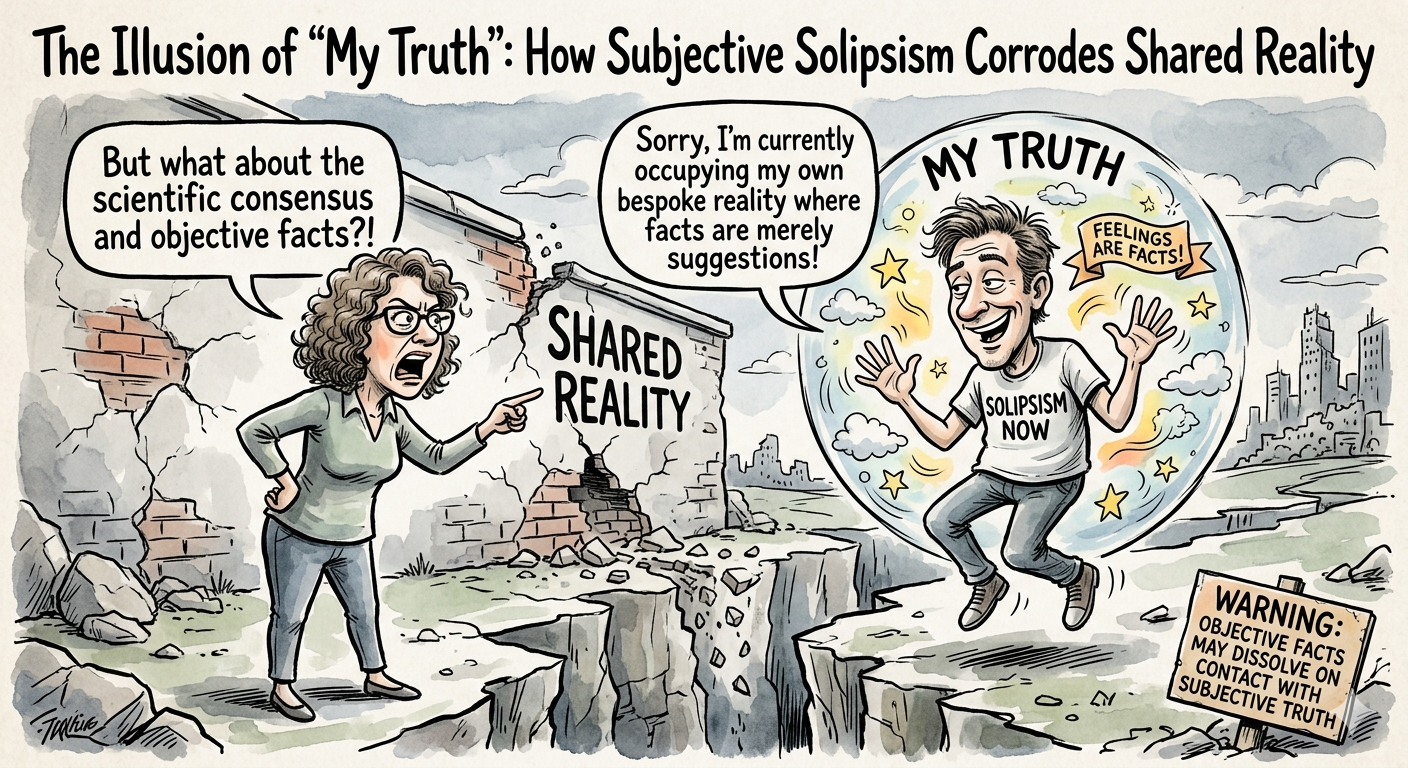
I need to vent about something that has been driving me absolutely crazy lately. It feels like everywhere I turn—whether I’m scrolling through social media, listening to a podcast, or god forbid, trying to have a serious disagreement with someone—I keep running into the phrase “my truth.”
I get where it originally came from. It started in therapy rooms and advocacy spaces as a way to help people speak up about their personal experiences without being brushed aside. That’s fine. But it has mutated into something deeply toxic. What started as a tool for emotional empowerment has turned into a massive excuse for pure selfishness, and I am completely exhausted by it.
Here is why this phrase is not just annoying, but genuinely destructive.
1. You Don’t “Own” Truth. That’s Not How This Works.
Let’s just look at the sheer logical absurdity of the phrase. By definition, truth isn’t something you can own. It doesn’t belong to me, and it doesn’t belong to you. Truth relies on objective reality.
If I say, “It is pouring rain outside,” that statement is only true if water is actively falling from the sky. It doesn’t matter if I feel like it’s sunny, or if “my truth” tells me it’s a beautiful beach day. The sky doesn’t care about my feelings.
When people slap a possessive pronoun onto the word truth—making it “my truth” or “your truth”—they are pulling an intellectual bait-and-switch. What they actually mean is “my opinion,” “my perspective,” or “my feelings.” But saying “my perspective” means your ideas can be questioned or debated. By rebranding a fleeting emotional state as “truth,” they are trying to claim the authority of an objective fact while demanding the absolute immunity of a personal feeling. It’s a total cop-out.
2. It’s a Shield for Flat-Out Selfishness
The most frustrating part about the “my truth” epidemic is how inherently selfish it is. It gives people a free pass to completely ignore reality if it makes them uncomfortable.
When your personal narrative becomes the supreme law of the land, inconvenient facts stop being corrective boundaries and start being treated as personal attacks.
Think about it: Someone can treat everyone around them like garbage, but then turn around and say, “Well, my truth is that I am the victim here.” Okay, but factually, you aren’t.
When we decide that “my truth” overrides objective verification, we are demanding that the entire universe bend to accommodate our ego. It allows people to live in these delusional, self-absorbed echo chambers where their biases are always validated and real, hard evidence is discarded simply because it hurts their feelings.
3. It Completely Erases the Other Person (and It’s Gaslighting)
This is where it gets incredibly messy in real life. When you weaponize “my truth” during a conflict, you are effectively shutting down any possibility of a fair conversation. Because if your viewpoint is an unassailable “truth,” then anyone who disagrees with you isn’t just offering a different perspective—they are actively denying your existence.
Imagine a bad breakup or a business partnership falling apart. If one person says, “My truth is that you deliberately tried to ruin my life,” they’ve just leveled a massive accusation without needing a shred of proof.
If the other person brings forward actual receipts, texts, and facts showing they acted in good faith, they get hit with: “You are validating your reality over mine! You’re denying my truth!”
It’s an incredibly manipulative power play. It creates a toxic dynamic where the person with the loudest emotional reaction gets to dictate the history of what happened. The intentions, actions, and very real experiences of the other people involved are completely erased. It is, quite literally, a form of socially sanctioned gaslighting.
4. It’s Breaking Our Ability to Live Together
On a macro level, this hyper-individualism is destroying our ability to have a functional society. We cannot live together if we don’t have a shared baseline of reality. Our legal systems, scientific progress, and basic neighborhood interactions rely on the idea that there are facts we can mutually agree upon through evidence and reason.
If we replace objective facts with a marketplace of competing narcissisms, everything falls apart:
- Justice becomes impossible if a defendant can just shrug and say, “Well, that’s your truth, but my truth is different.”
- Science becomes meaningless if data can be dismissed because it doesn’t align with someone’s self-concept.
The worst part? It kills empathy. How can we actually connect with or understand each other if we’ve destroyed the very bridge of a shared reality required to reach one another?
Can We Just Say “My Experience” Instead?
Look, I’m not saying people’s feelings don’t matter. Human suffering, joy, and individual perspectives are incredibly real and important. But we have to have the courage to separate our experiences from objective truth.
Phrases like “my experience,” “my perspective,” or “the way I feel” are honest. They leave the door open for conversation. They invite empathy because they acknowledge that you’re only seeing one piece of a much larger puzzle.
But “my truth” slams the door shut. It’s a selfish, lonely way to live, where you are the sole judge of reality, immune to critique, and totally blind to the wreckage you leave behind by ignoring everyone else. If we want to have healthy relationships and a society that actually functions, we need to drop the solipsism, grow up, and do the hard work of living in the same, shared reality.




Leave a comment