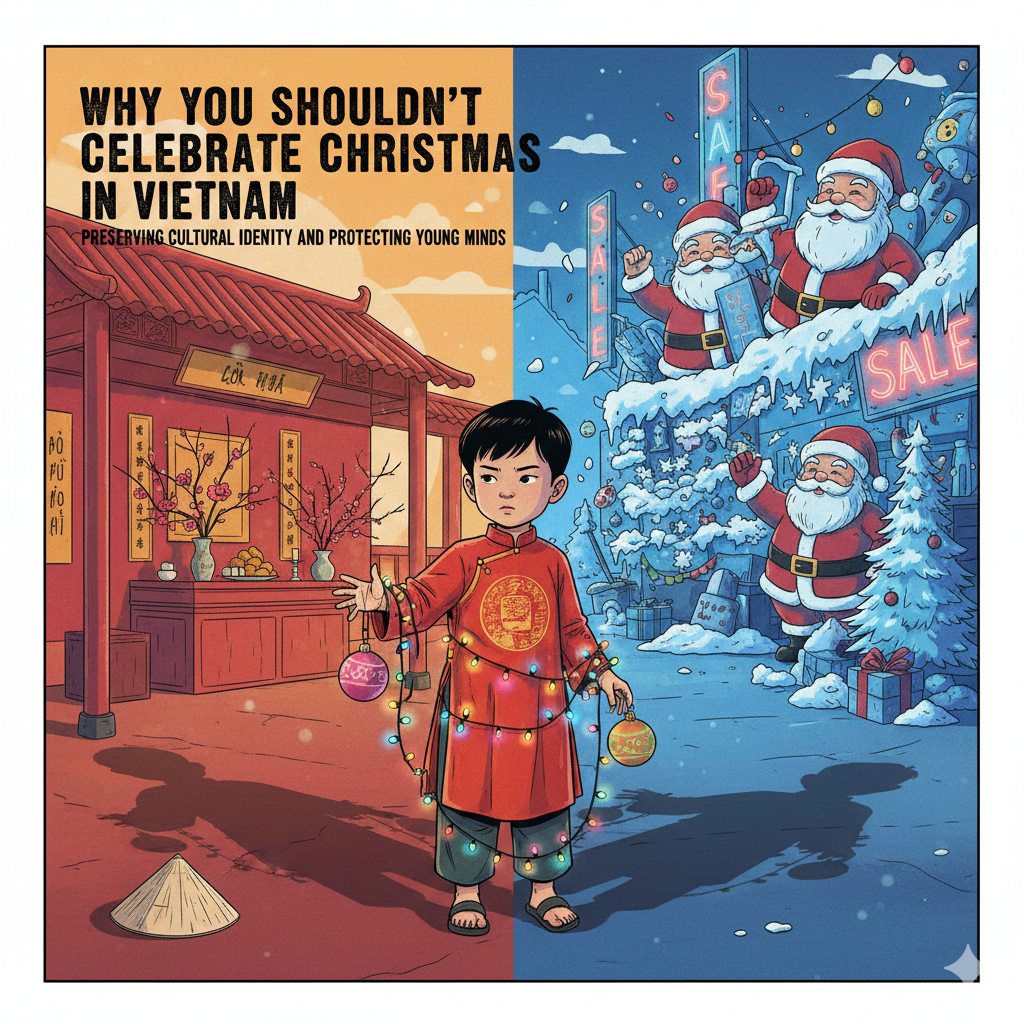
In the bustling streets of Hanoi and Ho Chi Minh City, as December rolls around, twinkling lights and festive decorations begin to appear in shopping malls and cafes. Santa Claus figures pop up in storefronts, and the air fills with the faint echo of carols. For many in Vietnam, this imported holiday has become a trendy occasion for parties, gift exchanges, and Instagram-worthy photos. But beneath the glitter lies a deeper question: Should Vietnamese families embrace Christmas, or is it time to step back and reconsider? As a Southeast Asian nation with a rich tapestry of indigenous traditions, Vietnam has much to lose by adopting foreign celebrations that don’t align with its cultural, social, and economic fabric. This article explores why celebrating Christmas in Vietnam might not be the best idea, particularly focusing on the psychological and social impacts on primary school and preschool children who miss out on gifts while watching their peers receive them. By prioritizing local festivals like Tet Nguyen Dan, we can foster a stronger sense of identity and equity among the youngest members of society.
The Cultural Mismatch: Christmas as an Imported Phenomenon
Vietnam’s cultural landscape is deeply rooted in Confucianism, Buddhism, and ancestral worship, with holidays that reflect agricultural cycles, family reunions, and spiritual harmony. Tet, the Lunar New Year, is the pinnacle of Vietnamese festivities, marked by cleaning homes, preparing banh chung (sticky rice cakes), and paying respects to ancestors. Mid-Autumn Festival brings mooncakes and lantern parades, emphasizing community and children’s joy. In contrast, Christmas originates from Christian traditions commemorating the birth of Jesus Christ, a narrative far removed from Vietnam’s historical and spiritual ethos.
Historically, Christmas arrived in Vietnam through French colonialism in the 19th century, primarily influencing Catholic communities in the south. Today, only about 7-8% of Vietnam’s population identifies as Christian, mostly Catholic, according to government statistics. For the majority—Buddhists, atheists, or those practicing folk religions—Christmas holds no religious significance. Yet, globalization and Western media have propelled it into the mainstream, turning it into a commercial spectacle rather than a spiritual event. Malls like Vincom Center in Hanoi transform into winter wonderlands, complete with artificial snow and reindeer, despite Vietnam’s tropical climate where December temperatures hover around 20-30°C. This artificial imposition can dilute authentic Vietnamese experiences, making locals feel pressured to conform to global trends rather than cherishing their own.
Celebrating Christmas risks eroding cultural identity. In a country where traditions like honoring the Kitchen Gods during Tet Ong Cong Ong Tao reinforce family bonds and gratitude, adopting Christmas can create a sense of cultural amnesia. Younger generations might prioritize Santa over the legend of the Vietnamese dragon and phoenix, symbols of national pride. This isn’t about xenophobia; it’s about preservation. Southeast Asian neighbors like Thailand and Indonesia face similar dilemmas, where imported holidays compete with local ones like Songkran or Eid al-Fitr. In Vietnam, skipping Christmas allows families to invest time and resources into Tet preparations, ensuring that children grow up immersed in stories of their heritage rather than borrowed myths.
Moreover, the environmental toll shouldn’t be overlooked. Christmas decorations often involve plastic trees, LED lights, and disposable wrapping paper, contributing to Vietnam’s growing waste problem. Hanoi and Ho Chi Minh City already struggle with pollution; adding seasonal trash from non-essential celebrations exacerbates this. By forgoing Christmas, Vietnamese households can model sustainability, aligning with national efforts like the government’s plastic reduction campaigns.
Economic Pressures and Social Inequality
Beyond culture, the financial burden of Christmas is a compelling reason to abstain. Vietnam’s economy, while growing rapidly with a GDP per capita around $4,000 in 2025, still sees many families living paycheck to paycheck. The holiday’s emphasis on gift-giving, lavish meals, and decorations can strain budgets. A simple Christmas tree might cost 500,000 VND ($20), while gifts for children add up quickly—action figures, dolls, or gadgets that parents feel obligated to buy to keep up with social media trends.
This commercialization is amplified by marketing from multinational corporations like Coca-Cola, whose Santa ads flood Vietnamese TV and billboards. Families in rural areas or lower-income urban neighborhoods might skip gifts altogether, leading to disparities that hit hardest during the school year. Primary school students (ages 6-11) and preschoolers (ages 3-5) are particularly vulnerable, as their worlds revolve around peer interactions. When classmates flaunt new toys or clothes received as Christmas presents, those without feel the sting of exclusion.
Consider a typical scenario in a Hanoi primary school: During recess, children share stories of their holidays. One child boasts about a new bicycle from “Santa,” while another, from a modest family, has nothing to show. This isn’t just about material possessions; it’s about the emotional fallout. Studies on child psychology, such as those from the American Psychological Association, highlight how perceived inequality in early childhood can lead to long-term issues like low self-esteem and social withdrawal. In Vietnam, where education emphasizes collectivism, such divisions contradict the communal spirit fostered in schools.
The Psychological Effects on Children Who Don’t Receive Presents
The core concern here is the impact on young students who don’t get Christmas gifts while witnessing their classmates’ excitement. For preschoolers, whose cognitive development is in its formative stages, holidays are about wonder and fairness. Piaget’s theory of cognitive development suggests that children at this age (preoperational stage) think egocentrically, struggling to understand why they are left out. Seeing peers with shiny new toys can trigger feelings of jealousy, inadequacy, and confusion. “Why didn’t Santa come to me?” a child might wonder, internalizing it as a personal failing or parental neglect.
In Vietnamese preschools, where activities often involve group play, this disparity becomes amplified. A child without a gift might avoid sharing circles or become disruptive, seeking attention through negative behaviors. Long-term, this can affect emotional regulation. Research from Vietnam’s Ministry of Education and Training indicates that early experiences of social inequality correlate with higher rates of anxiety in elementary years. Parents who can’t afford gifts face guilt, sometimes borrowing money or cutting essentials, which adds family stress that children sense intuitively.
Primary school students, slightly older, experience these effects more socially. Bullying or teasing can emerge, with phrases like “You must have been naughty” echoing playground taunts rooted in Christmas lore. This fosters a competitive rather than cooperative environment, clashing with Vietnam’s educational values of harmony and mutual support. A 2023 study by UNICEF Vietnam on child well-being found that material disparities during holidays contribute to 15-20% of reported peer conflicts in urban schools. Children who don’t receive presents may develop resentment toward the holiday, associating it with pain rather than joy.
Positive effects for those who do receive gifts are often short-lived. The thrill of a new toy fades, but the pressure to reciprocate or maintain status persists. For non-recipients, the absence can build resilience if framed positively—parents explaining cultural priorities over consumerism. However, without guidance, it leads to negative outcomes like decreased motivation in school. A child feeling “less than” might disengage from lessons, impacting academic performance. In preschool, this manifests as reluctance to participate in art or play, stunting creativity.
Socially, these experiences shape worldview. Children learn early about economic divides, which in Vietnam’s rapidly urbanizing society, can exacerbate class tensions. Wealthier families in districts like District 1 in Ho Chi Minh City might lavish gifts, while those in outskirts like Binh Chanh opt out. This mirrors broader Southeast Asian issues, where holidays like Christmas widen urban-rural gaps.
Broader Societal Implications and Alternatives
Celebrating Christmas also promotes individualism over collectivism, a core Vietnamese value. Gifts focus on personal gratification, whereas Tet’s lucky money (li xi) is communal, shared among family. By skipping Christmas, parents teach delayed gratification and appreciation for non-material joys like family time or homemade treats.
The effects extend to family dynamics. Parents under pressure to provide gifts might work overtime, reducing quality time with children. This is particularly acute for migrant workers from provinces like Nghe An, who send money home but miss holidays. Children left with grandparents feel the void doubly— no gifts and absent parents.
Instead, embrace Vietnamese alternatives. During December, focus on Dong Chi (Winter Solstice), with warm che (sweet soup) gatherings. This builds community without the commercial hype. For children, channel excitement into Tet preparations, like making lanterns or learning folk songs. Schools can reinforce this by organizing cultural events, reducing peer pressure around foreign holidays.
In conclusion, while Christmas offers fleeting fun, its adoption in Vietnam undermines cultural authenticity, strains finances, and creates emotional hurdles for young children. Primary and preschool students who miss out on gifts while seeing classmates’ hauls face jealousy, low self-esteem, and social isolation, effects that ripple into their development. By choosing not to celebrate, Vietnamese families honor their roots, promote equity, and nurture resilient, culturally grounded children. Let’s light incense for ancestors instead of stringing lights for Santa—true joy lies in what we’ve always had.






Leave a comment