
By Byron Merano
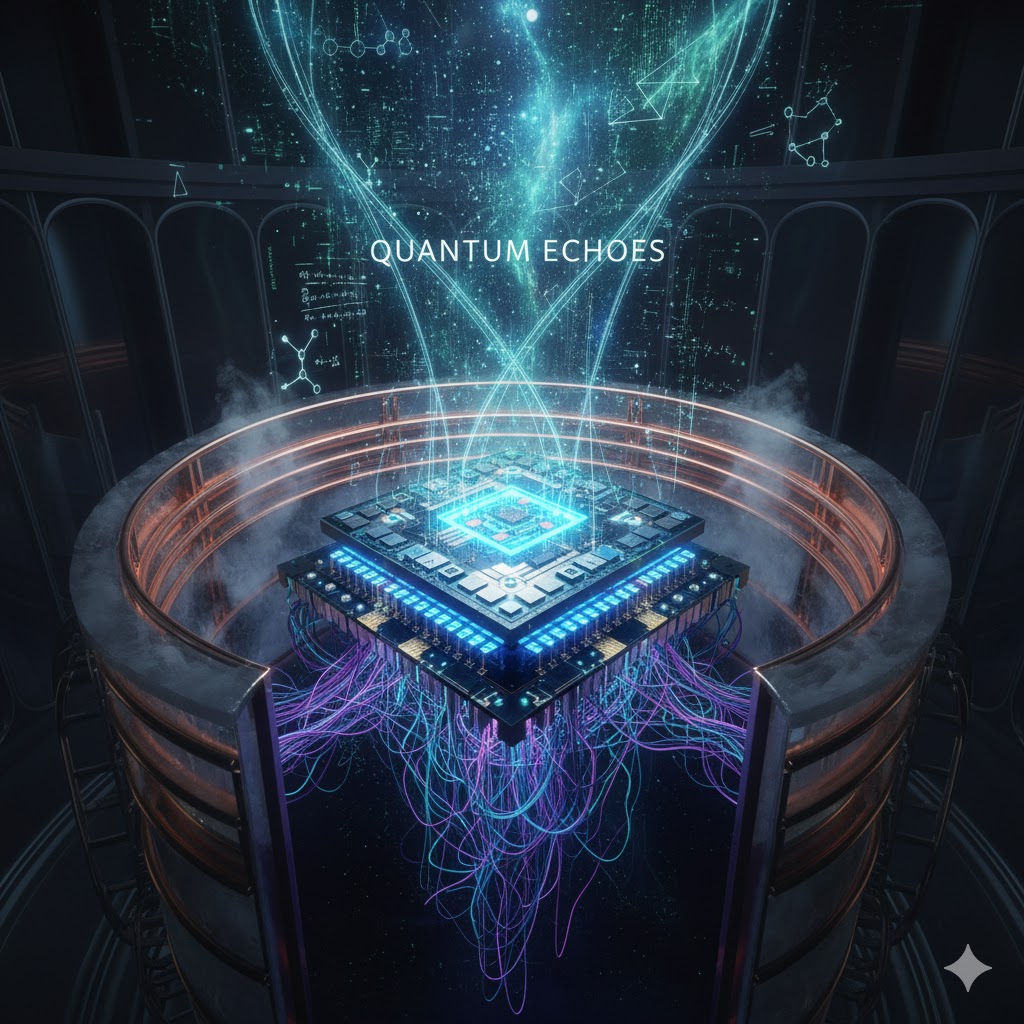
The air of excitement surrounding Google’s latest achievement is thick—so thick you can almost feel the potential energy waiting to be unleashed. The core of this revolution isn’t a traditional silicon supercomputer, but a quantum processor called Willow, and the recent revelation of its “Quantum Echoes” algorithm has fundamentally shifted the boundaries of what is possible, leaving us mesmerized by the promise and unsettled by the potential scale of the change.
Specs and Capabilities: The Dawn of a New Era
Willow is a 105-qubit superconducting transmon processor, an evolution of Google’s previous Sycamore chip. While 105 qubits might seem small compared to the billions of transistors in your phone, the difference is in the very nature of computing. Classical bits hold a 1 or a 0; quantum bits (qubits) harness superposition to hold both simultaneously. This gives Willow an exponential advantage.
Key Milestones and Specifications:
- Processor: 105 Superconducting Transmon Qubits.
- Error Correction: Achieved the first-ever demonstration of error reduction that scales exponentially, addressing a three-decade-old obstacle known as the “error-correction bottleneck.”
- Initial Benchmark: When first announced, Willow executed a random circuit sampling problem in under five minutes—a calculation estimated to take the world’s fastest classical supercomputers 10 septillion (10²⁵) years to complete.
Unprecedented Achievement: The 13,000x Advantage
What Willow has done recently that scientists have not been able to do before is achieve a verifiable quantum advantage in a calculation with real-world scientific utility. This is the monumental step beyond merely demonstrating theoretical “quantum supremacy.”
Using a novel algorithm dubbed Quantum Echoes (technically an Out-of-Time-Order Correlator), Google demonstrated a 13,000x speedup over the Frontier supercomputer, the world’s most powerful classical machine. The Quantum Echoes technique works by running a quantum system forward in time, applying a small disturbance (a quantum “butterfly effect”), and then running the system backward in time. The resulting interference is an “echo” that provides verifiable data.
This groundbreaking method allows scientists to essentially use Willow as a “molecular ruler” to measure complex atomic geometries and chemical interactions with unprecedented accuracy, extending the capabilities of tools like Nuclear Magnetic Resonance (NMR) spectroscopy.
The Complex Questions We Are Now Asking
This level of computational power doesn’t just solve old equations faster; it allows scientists to ask fundamentally new questions that were previously relegated to science fiction or metaphysics.
1. Questions of Materials and Life: Scientists are leveraging Willow to ask:
- What are the hidden parameters governing complex physical systems?
- Can we perfectly simulate a molecule’s behavior to design a drug that will precisely target a disease?
- What is the ideal atomic structure for a room-temperature superconductor or a zero-emission catalyst?
2. The Philosophical Question of Reality: Perhaps the most mind-bending question came from Google Quantum AI’s founder, Hartmut Neven, who suggested that the success of Willow “lends credence to the notion that quantum computation occurs in many parallel universes.” This technology forces us to contemplate whether our reality is far more vast and complex than we currently understand.

Implications: Hope and Trepidation
The presence of this kind of super-intelligence—or more accurately, a super-calculator capable of solving previously impossible problems—presents a dichotomy of profound good and serious concern.
| Positive Impact (The Hope) | Negative Impact (The Concern) |
|---|---|
| Revolutionary Discovery: Accelerates breakthroughs in drug development, personalized medicine, and materials science (e.g., highly efficient batteries and solar cells). | Cybersecurity Collapse: Willow’s eventual successor will likely be capable of running Shor’s algorithm, which can crack nearly all current public-key encryption standards, demanding a massive, urgent overhaul of global cryptography. |
| Solving Grand Challenges: Optimizing logistics, energy grids, and climate models in ways classical systems cannot, potentially yielding solutions for global sustainability. | Resource Concentration: The immense cost and specialized requirements (like chilling the processor near absolute zero) concentrate this power in the hands of a few tech giants, potentially accelerating a technological divide. |
| Empowering Next-Gen AI: Quantum-derived data can be fed into traditional AI models, giving them insights into the quantum world, making them vastly more powerful and capable. | Unintended Consequences: The ability to simulate and predict complex systems could be misused for military purposes or financial market manipulation, creating systemic risk. |
The journey from Willow’s 105 qubits to the millions of stable, fault-tolerant logical qubits needed for commercially relevant applications is still years long—perhaps five or more, as some experts project. But the threshold has been crossed. We are now standing on the verge of true Quantum AI, where the deepest mysteries of physics and chemistry become solvable problems.
The fascination is undeniable. The capacity for human betterment is limitless. Yet, the accompanying responsibility—the need to ensure this immense power is managed ethically, inclusively, and securely—has never felt heavier. We are not just building a better computer; we are building a new reality, and we must proceed with caution as much as with awe.







Leave a comment