By Byron Merano

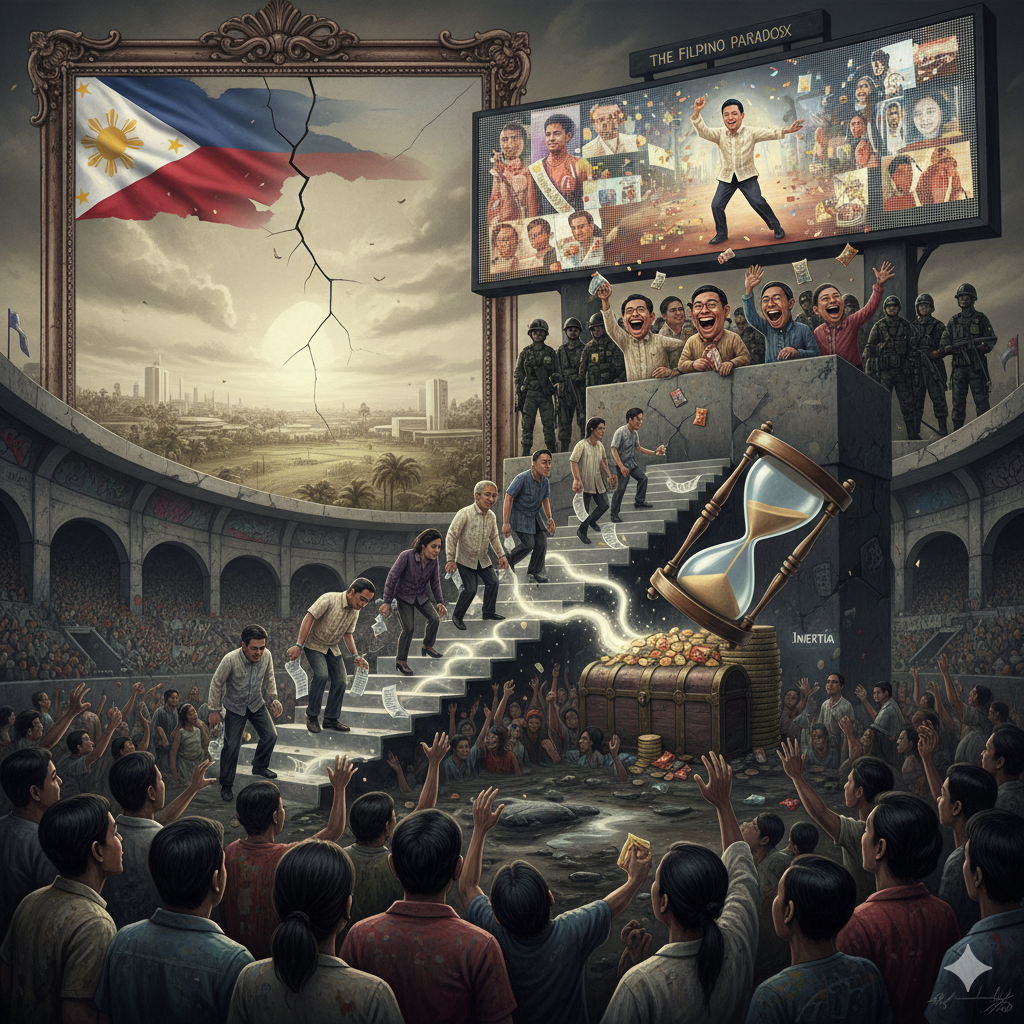
To understand the Philippines today is to witness a nation trapped between a storied past and a stagnant present. While Filipinos take immense pride in being a “unique” cultural bridge between the East and West, this pride often acts as a shield against the uncomfortable realities of their social and political landscape.

The “Missing Middle” and the Tax Burden
The Philippine economic structure functions on a polarizing “sandwich” model. At the top, the political and economic elite reap the rewards of state contracts and policy favors. At the bottom, the impoverished majority receive intermittent government subsidies and “ayuda” (handouts)—measures that offer temporary relief but ultimately keep them in a state of dependency.
The burden of bankrolling this system falls squarely on the middle-class taxpayers.
- The Tax Trap: Salaried professionals are the only demographic whose taxes are automatically deducted, leaving them with no way to avoid funding a system that offers them little in return.
- The Subsidy Cycle: These taxes fund the “goodies” for the rich and the survival of the poor, yet the middle class often lacks the social safety nets or quality public services they are paying for.
The Defense Mechanism: Defensiveness over Reflection
A significant barrier to progress is a collective lack of self-reflection. When international observers or fellow Filipinos point out systemic flaws, the response is often “onion-skinned” defensiveness—an immediate, angry rejection of the truth.
This sensitivity stems from a refusal to acknowledge that the “Filipino condition” is not just imposed from above but perpetuated from within. By accepting corruption as an inevitable “norm,” the populace inadvertently validates the status quo. Neighbors in Southeast Asia—nations the Philippines once surpassed in the mid-20th century—now look on with a mixture of pity and bewilderment at a country that seems unable to break its own chains.
The “Colosseum” and State Control
The government maintains control through a modern version of “Bread and Circuses.” By funding lavish events and minor infrastructure projects, politicians keep the public entertained and distracted from the massive siphoning of public funds.
To ensure this cycle remains undisturbed, the state has prioritized the military and police, recently approving substantial salary increases to ensure the loyalty of the armed sectors. This creates a protective “praetorian guard” for the elite, while essential sectors like Education and Healthcare face budget cuts. The proposal to downgrade Nursing to a shorter “associate” course is seen by many as a desperate attempt to monetize labor while stripping away the professional dignity of a field that provides the nation’s primary export.
The Revolutionary Dilemma
True change requires a complete overhaul of the government, yet the path to such a transformation is blocked by a pervasive cultural desensitization. The “Filipino mob” has seen so many scandals and crises that they have become numb to them.
While history suggests that only a fundamental revolution could dismantle these entrenched power structures, the collective will for such an upheaval has been eroded by years of survival-mode living and state-sponsored entertainment. The tragedy of the modern Filipino is the awareness of what the country once was—the “Pearl of the Orient”—contrasted with a present where change is viewed as impossible.
Moving Forward
Addressing these issues requires moving beyond “Pinoy Pride” and embracing radical accountability. It begins with the individual’s refusal to accept mediocrity and corruption as cultural traits.
https://www.adb.org/publications/poverty-philippines-causes-constraints-and-opportunities
https://www.econstor.eu/obitstream/10419/46668/1/538098074.pdf
https://www.philstar.com/business/2023/09/25/2298732/why-we-may-be-poor-forever

Leave a comment