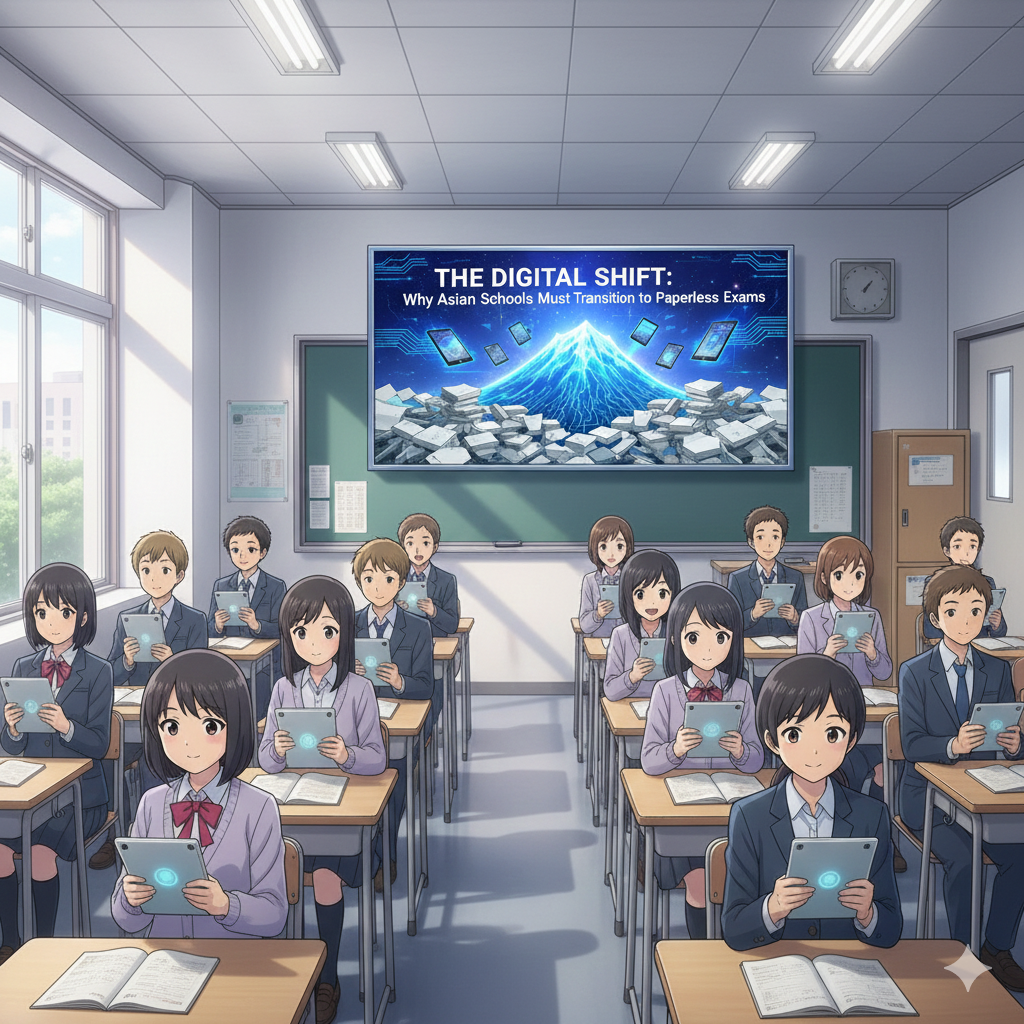
“From Paper Mountains to Digital Mastery Stop the grading grind. Transition to paperless exams and give your teachers the time they deserve to teach!”
In the heart of many Asian households, the sound of a rustling page is synonymous with academic rigor. For decades, the “pen and paper” model has been the gold standard of excellence across the continent. From the Gaokao in China to the JEE in India and the HSC in Southeast Asia, high-stakes testing is woven into the cultural fabric.
However, as we move further into the 21st century, a glaring contradiction has emerged. While Asia leads the world in tech innovation, high-speed rail, and digital payments, its classrooms are often anchored to a 19th-century examination model. It is time for Asian schools to embrace paperless exams—not just for the sake of technology, but to liberate teachers, empower students, and refocus on the true goal of education: teaching.
1. The Heavy Burden: Why the Current System is Breaking
In many Asian educational cultures, the “Tiger Teacher” or the tireless educator is celebrated. But behind this image lies a grueling reality. Teachers spend hundreds of hours every academic year on manual labor that has nothing to do with instruction.
The Grading Marathon
Consider a typical secondary school teacher in a densely populated city like Jakarta, Manila, or Ho Chi Minh City. They may be responsible for five classes, each with 40 to 50 students. After a mid-term exam, that teacher is faced with 250 physical test papers.
Checking these papers involves:
* Manually verifying every multiple-choice answer.
* Reading handwritten essays (often under time pressure).
* Manually calculating totals and cross-referencing mark sheets.
* Physically transporting stacks of paper from school to home.
This “checking fatigue” leads to human error and, more importantly, burnout. When a teacher spends their weekend tallying marks, they aren’t spending it refining their next lesson plan or resting to be their best self for their students.
2. Transitioning to Online: The “Easy” Revolution
The move to online exams is often met with resistance due to a fear of complexity. However, the reality is that digital platforms offer an “Ease Triple Threat”: Easy Taking, Easy Checking, and Easy Evaluation.
Easy Test Taking
For students, digital exams remove the physical constraints of the paper era.
* Legibility: No student is penalized because their handwriting was messy under stress.
* Flexibility: It is far easier to edit a digital essay—cutting, pasting, and reorganizing thoughts—than it is to scribble out lines of text on a limited piece of paper.
* Accessibility: Digital exams can easily accommodate students with visual impairments or learning disabilities through screen readers and adjustable font sizes.
Easy Checking (The Teacher’s Gift)
This is where the most significant impact occurs. For objective questions (Multiple Choice, True/False, Matching), the grading is instant. The moment a student hits “Submit,” their score is calculated.
For subjective answers, digital platforms allow teachers to use “Rubric Overlays.” Instead of writing the same comment (“Incomplete thesis statement”) 50 times by hand, a teacher can click a pre-set feedback button. This doesn’t just save time; it ensures consistency in grading across the entire student body.
Easy Evaluation and Data Analytics
In a paper-based system, if a teacher wants to know which question the class struggled with most, they have to manually count the wrong answers across 250 papers.
In a paperless system, the software provides an instant Item Analysis. A teacher can see a bar graph showing that 70% of the class missed Question 14. This allows for “Just-in-Time” teaching—the teacher can walk into class the next day and specifically address that knowledge gap, rather than moving on blindly.
3. Addressing the “Asian Context”: Integrity and the Digital Divide
A common concern in Asian education is academic integrity. In a culture where exam results define a child’s future, the fear of cheating is high.
However, modern Computer-Based Testing (CBT) is often more secure than paper:
* Question Shuffling: No two students sitting next to each other have the same question order.
* Lockdown Browsers: Computers can be locked so students cannot access the internet or other files during the test.
* AI Proctoring: For remote exams, AI can detect suspicious movement or the presence of secondary devices.
Furthermore, while the “Digital Divide” (access to devices) is a real challenge in rural areas, many Asian governments are already investing heavily in “One Student, One Tablet” initiatives. Transitioning exams to these devices justifies the investment and prepares students for a workplace that is 100% digital.
4. Environmental and Economic Impact
Asia is home to some of the world’s most vulnerable ecosystems. The sheer volume of paper used for mock exams, unit tests, and final finals is staggering.
* Waste Reduction: Millions of tons of paper are discarded annually after the “results appeal” period ends.
* Logistical Savings: Schools spend a fortune on printing, ink, physical storage, and secure transport (armored trucks for national exams).
By going paperless, schools can reallocate those “paper budgets” toward high-quality digital resources, faster internet for the campus, or teacher development programs.
5. The Ultimate Goal: More Focus on Teaching
The most compelling argument for paperless exams isn’t about the gadgets—it’s about human connection. The “Checked by a Human” model is often seen as more personal, but in reality, a tired teacher grading papers at midnight is not a “personal” experience for the student. It is a mechanical one.
When we automate the clerical work of checking tests, we give the teacher back their most precious commodity: Time.
* Time to mentor a struggling student.
* Time to research new, creative ways to explain complex concepts.
* Time to engage in professional development.
In the traditional Asian classroom, the teacher is often a “Sage on the Stage,” burdened by administrative tasks. By going paperless, we allow the teacher to become a “Guide by the Side.”
6. How to Start the Transition
Schools don’t have to change overnight. The transition can be a phased approach:
* The “Hybrid” Phase: Keep final exams on paper if the law requires it, but move all weekly quizzes and unit tests to a Learning Management System (LMS) like Google Classroom, Moodle, or Canvas.
* The “Bring Your Own Device” (BYOD) Phase: Encourage students to use their own laptops or tablets for in-class assessments.
* The “Full Digital” Phase: Invest in school-owned “Chromebook Carts” that move from room to room for standardized testing.
Conclusion: A Future-Ready Asia
If we want Asian students to be the innovators, engineers, and leaders of tomorrow, we cannot test them using the technology of yesterday.
Paperless exams are not a “luxury” for elite international schools; they are a necessity for every local school that wants to provide a high-quality, data-driven, and humane education. By removing the “tons of test papers” from our teachers’ desks, we aren’t just making their jobs easier—we are making their teaching better.
It is time to close the paper booklets, put down the red pens, and log on to a more efficient, fair, and sustainable future for Asian education.







Leave a comment