By Ramzzi Farinas

More than any white-collar profession, being a teacher is considered the most precarious and vulnerable in these contemporary times. From being a noble profession which hones students of all colors and classes in realizing their utmost potential as individual critical inquirers, nation-recognizing community-builders, and global citizens open to various races and cultures—being a teacher has suffered so much after being neglected for far too long by the government and various stakeholders which operate the academic sphere. Mostly denied for salary increase and employee benefits, teachers are also suffering in doing additional office tasks, often administrative and outright many and heavy, if not being bent and fragmented due to many requisites, such as securing classrooms and school uniforms, which they instead prepare by themselves rather than stupidly reiterating these needs to the respective authorities which should have provided them in the first place. In its extreme, being a teacher is considered like any Filipino worker: overtly worked, underpaid—exploited. In a specific case, the teacher is a worker who goes through the bargain of contractualization, only to be discarded when the certain duration of the contractualization is met. Such is the case of Jose Mario de Vega.
De Vega was already an Associate Professor I of National University (NU) and already serving two years and a half of the said rank, when all of a sudden—he was no longer given a teaching load for the semester just this year, 2025. Such act of bypassing a professor is already a sign that he or she is no longer demanded to teach, that is, he or she is already fired from the faculty, from the university itself. In a word, de Vega was unceremoniously dismissed by NU.
Little did the university know, what they discarded is someone who consigns never to despair: de Vega immediately stood up and started a painstaking crusade to demand what is right for him. Little did the university know, de Vega is a unique teacher; and this essay focuses on who he is, what is his fight all about, and what it means to all of us.
De Vega: The Teacher of Many Sides
De Vega is a dominant voice in the Philippine intelligentsia. Having been trained in philosophy, history, law, and even attended conferences on literary translation and led seminars on labor laws and workers’ rights, de Vega as a teacher of ethics and the social sciences is only one side of his being. He has taught in many universities in Metro Manila and even abroad, and yet, NU—if not, in general, the academic sphere—could not see what they were missing from this experienced professor. Consider the titles he produced: Dissidente (2013), Insurrecto (2017), Pantayong Pananaw at Paninindigang Pulitikal (2021), (Pravda) Ang Digmaang Proxy sa Ukraina: Rusya Laban sa NATO (2022), and Kontra Imperyalismo at Henosidyo: Ang Palestina sa Kuko ng Zionismo at Neokolonyalismo (2024). All these titles are a testament of a courageous mind, not minding the discourse of bourgeoisie academics and their superficial niceties. Rather, he took the road less traveled and went on against the grain of mainstream publishing. Consider also the capsule pieces, the short flames of his thought, published in national broadsheets, academic journals, and his own blog. Such works are never deficient of criticality, engaging people to be active on social and intellectual issues; more so scolding and criticizing prominent figures who, active they might be on social and intellectual issues, are still blinded by their privileged but subpar viewpoints. These figures numbered are no less than the public historian Ambeth Ocampo, the National Artist for Literature Virgilio Almario, among others, who, for de Vega, were saying the wrong things because they were fighting for the wrong ones. Behind such intellectual stature, de Vega is a joyous familial animal, married, and a father of three children, as evidenced of his daily social media posts.
De Vega’s Fight as Our Fight
It is an utmost rarity to see that an intellectual goes to the level of a philosopher and breathes fire to the issues of what matters most in life. To consider the very ground where scrutiny and lived experiences should be co-existent, while not losing the very sight of the questions of how to live, and most especially, the singular questions of why.—Why fight?
Under the neoliberal capitalist system, having the choice to fight, more so on the very thought to fight itself, has been made nearly impossible. People as workers are considered as mere workers here, and with such ideological conditioning, the system happily compresses the majority of the public as a privatized workforce where each person is only a unit, a “human resource,” under contract for six months, and soon after, discarded, that is, not regularized for full-time employment, by which stable monthly salary and employee benefits await. They are bereft of financial security, hence. Such harsh economic context disables people to think if they can fight, or most importantly, to think if they should fight. Oftentimes, people are persuaded they are only individuals before institutions, and with the almighty position of an edifice, a place of power and policy which hovers, this leaves them no option but to turn away and accept the very fate given, for this is the rule of the system after all, by which the institutions heartlessly uphold for their own profit-driven interests. In de Vega’s case, the system has the Manual of Regulations for Private Higher Education (MORPHE) which mandates professors in private universities need to be employed for three years before becoming regular employees. NU did not even wait for three years to sack de Vega.
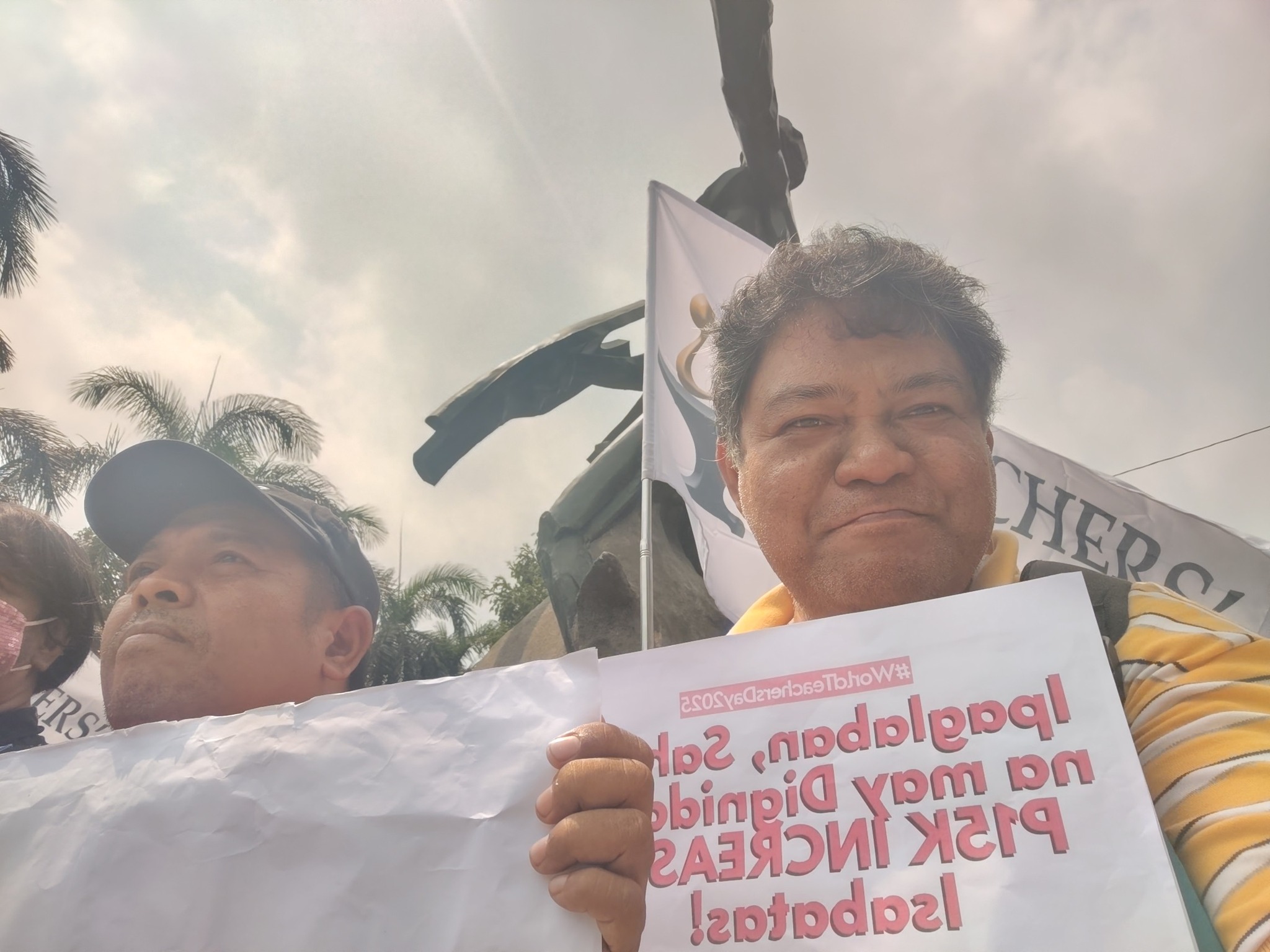
As said, the teacher here consigns never to despair. De Vega has already forwarded his case to many available avenues—from the Labor Department to the social media, from various cause-oriented groups, especially the labor and youth sectors, to the Congress, and even to the streets—while all along he continues to channel his energy in letting every teacher and worker know that his fight is not an isolated one. In solidarity of his cause, various groups are not only condemning NU for its apathy to dismiss professors, but also the very laws which the university is—and perhaps, also other universities and colleges are—abusing. The Philippine government has much to say on this, for, in the long history of contractualization and labor rights—how did this lead to de Vega, that is, him being an exemplar of a teacher as a worker dismissed with a law which is already abusive in the first place? In a wider context, how many more are like him, which are being denied the full-time or regular employment due to MORPHE?
. . .
Since time immemorial, teachers have been the shapers of people’s outlook before they become workers. However, with public institutions being privatized, especially universities and colleges adopting neoliberal policies and outlooks (NU is a private university), the nobility of the teaching profession is being reduced to a contract. From this contract lies not only the profession in a certain duration, but also the very dignity of the teacher as a worker, the teacher as an intellectual voice, the teacher as a financial and joy provider for his or her family, and the teacher who is not merely a replaceable unit of labor but an individual who can fight, should fight for his rights. De Vega’s fight is our fight. It is much syllogism to say that for all X, there is an X’, but, as already made clear in this case, that is, in a literal sense—for all of us as workers, there is a de Vega who has been dismissed. Not only dismissed but dismissed from a profession which has honed us the most. The system, the laws, the government, the schools are very much the institutions which darkened this once-great profession; and yet—there is a fire from the dismissed, there is a fire from de Vega.
From the individual to the collective, such fire is passed on, to keep everyone’s minds and hearts ablaze, and from this, gather all available support and solidarity to burn the very contract of unjust and inhumane labor.






Leave a comment