By Byron Merano
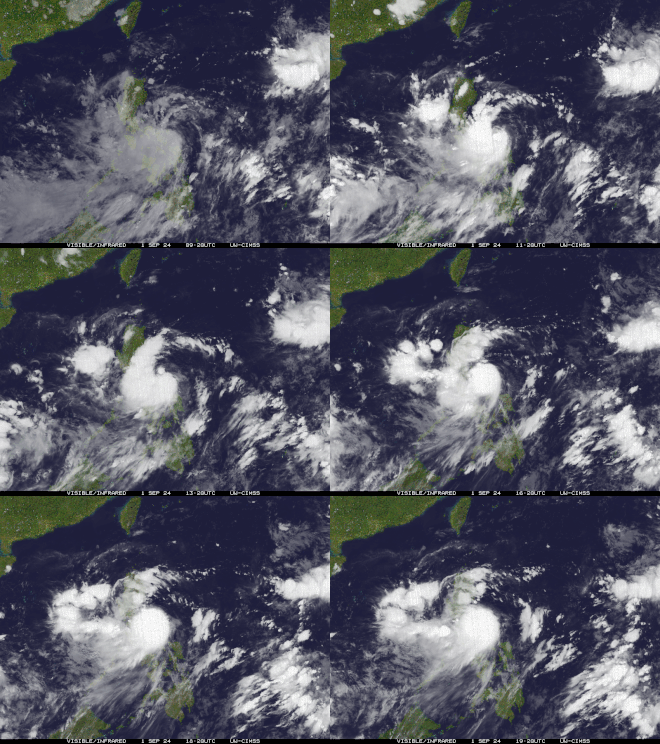
The 2025 monsoon and typhoon season, stretching from September through November, delivered an unprecedented series of climate shocks to Southeast Asia. Countries including Vietnam, Thailand, the Philippines, Malaysia, and Indonesia were battered by relentless, back-to-back tropical systems, marking one of the most punishing wet seasons in recent history.

The Storms and the Staggering Human Cost
The core of the devastation in September, October, and November 2025 was driven by several powerful typhoons and tropical depressions. Key among them were Typhoon Bualoi and Typhoon Matmo, which struck Vietnam in late September, and Typhoon Kalmaegi and Typhoon Fengshen, which caused catastrophic damage across the Philippines and central Asia in November. The cumulative impact was simply overwhelming.
| Country | Casualties (Dead/Missing) | People Affected (Approx.) | Property Damage (USD) |
| Philippines | Over 276 | Approximately 12 million (from Kalmaegi & Fengshen) | Data Pending |
| Vietnam | Over 98 (in Nov rains alone) | Millions displaced, 1.9 million without power | Total economic losses for 2025 exceeding $3.2 billion |
| Thailand | At least 145 | At least 1.9 million | Data Pending |
| Indonesia | Over 174 (in Sumatra) | Thousands relocated | Data Pending |
Export to Sheets
Structural and Economic Damages: The storms inflicted enormous structural damage. In the Philippines, over 531,000 houses were reported as damaged or totally destroyed by Typhoons Kalmaegi and Fengshen alone. Vietnam saw over 337,000 houses either collapsed, swept away, or severely damaged in 2025, with major flooding inundating more than 200,000 homes in November. In Indonesia, flash floods damaged or destroyed nearly 2,000 schools, homes, and other buildings.
The agricultural sector across the region has been crippled, with Vietnam alone facing losses estimated at $545 million in its central region, delaying critical harvests and threatening food security for the coming months.
Heavily Hit Locations:
- Vietnam: Central regions, including Dak Lak, Gia Lai, Khánh Hòa, Quảng Trị, and Hà Tĩnh, were submerged under record-high floodwaters.
- Thailand: Southern provinces were severely affected, particularly the city of Hat Yai (Songkhla province), where floodwaters rose to the ceiling of the second floor in some homes.
- The Philippines: Major displacement and destruction occurred across key regions like CALABARZON, MIMAROPA, and Caraga.
- Indonesia: The islands of Sumatra and Aceh were devastated by deadly landslides and rapid flash floods.
Government Responses: A Study in Contrasts
In the face of such adversity, regional governments have been tasked with leading the immediate relief and long-term recovery efforts.
Vietnam: Doing Everything They Can
The Vietnamese government’s response has been marked by strong, decisive action, earning commendation from international organizations. Upon the landfall of Typhoon Bualoi and subsequent storms, the government activated its national disaster response mechanism with proactivity and urgency.
Specific Actions by the Vietnamese Government:
- Mass Mobilization: The military, police, and security forces were swiftly deployed, conducting search-and-rescue operations and pre-emptively evacuating over 53,000 people from high-risk zones.
- Highest-Level Directives: Prime Minister Pham Minh Chinh signed an urgent official dispatch, and the Government issued Resolution No. 380/NQ-CP (November 25, 2025), emphasizing a “strong determination, great effort, and decisive, focused action.”
- Direct Aid Delivery: Authorities utilized helicopters and drones to transport food, medicine, and essential supplies directly to isolated and cut-off households, with a strict goal of ensuring “no one is left without food, clothing, or clean water.”
- Financial Commitment: Hanoi provided emergency aid of VND200 billion (approx. $7.6 million) to the hardest-hit provinces, underlining a comprehensive effort supported by local and central authorities.
The Contrast: Structural Failures and Criticized Responses
In contrast to the lauded, unified response in Vietnam, recovery efforts in other heavily-hit nations have been undermined by systemic failures and public dissent.
In Thailand, despite the deployment of naval assets for relief, the central government’s response faced growing public criticism. The severity of the disaster in Hat Yai led to the suspension of two local officials over alleged failures in the initial flood response, highlighting deficiencies in local disaster preparedness and management.
Meanwhile, in the Philippines, where millions were displaced, the government’s response was overshadowed by widespread public outrage over a lack of adequate protection infrastructure. Hundreds of thousands of people protested the government’s flood protection systems, which, according to reports, were either “not built to proper standards or was not built at all.” This structural neglect meant that when the typhoons hit, communities were left acutely vulnerable, leading to catastrophic loss of life and property that might otherwise have been mitigated. This critical gap between immediate aid distribution and fundamental risk reduction demonstrates a failure to fully safeguard the most vulnerable populations from predictable climate threats, especially when compared to Vietnam’s lauded early mobilization and command structure.
A Global Hand of Solidarity
As the region struggles to recover, the international community has responded with overwhelming generosity and solidarity, offering millions in humanitarian assistance.
International Aid to Southeast Asia (Focusing on Vietnam):
- South Korea (RoK): Provided a substantial emergency aid package of $1 million.
- United States: Committed a total of $1 million in assistance to address urgent needs like shelter and clean water.
- New Zealand: Announced multiple tranches of support, totaling over NZD4 million (approx. $2.27 million) for disaster relief.
- Australia: Pledged significant support, with an additional AUD800,000 for communities in Central Vietnam, building on earlier contributions.
- Russia: Delivered a shipment of life-saving equipment, including 58 rescue and work boats, tents, blankets, and canned food, directly to Hue City.
These donations, totaling nearly $16 million in financial assistance and supplies to Vietnam alone, reflect a shared humanitarian commitment to aiding the affected communities and helping them rebuild their fractured lives. The road to recovery will be long and arduous, but the resilience of the Southeast Asian people, coupled with decisive government action and global solidarity, offers a beacon of hope amid the flood-stricken landscape.
2025 Southeast Asia Severe Storms – Center for Disaster Philanthropy (Focus on impact across multiple countries): https://disasterphilanthropy.org/disasters/2025-southeast-asia-severe-storms/
Relentless Storms And Floods Devastate Southeast Asia In 2025 – Evrim Ağacı (Focus on economic losses and storm count): https://evrimagaci.org/gpt/relentless-storms-and-floods-devastate-southeast-asia-in-2025-517828
Truly severe’ floods overwhelm Southeast Asia – VN Express International (Focus on Thailand and Indonesia damage): https://e.vnexpress.net/news/news/environment/truly-severe-floods-overwhelm-southeast-asia-4987143.html
ASEAN Weekly Disaster Update Week 46 | 10 – 16 November 2025 – ReliefWeb (Detailed Philippines casualty and damage report): https://reliefweb.int/report/philippines/asean-weekly-disaster-update-week-46-10-16-november-2025
VIET NAM: JOINT RESPONSE PLAN MULTIPLE TYPHOONS AND FLOODS (2025) – UN in Viet Nam (Detailed Vietnam response and international coordination): https://vietnam.un.org/en/304102-viet-nam-joint-response-plan-multiple-typhoons-and-floods-2025






Leave a comment