By Byron Merano

Every generation is shaped by the technology and crises of its time, but Generation Beta (born roughly between 2025 and 2039) is poised to be profoundly different from all cohorts before it. Unlike Millennials (who adopted the internet) and Gen Z (who grew up with social media), Gen Beta is the first true AI native generation. They will not transition into a world of artificial intelligence; they will be born directly into an environment where AI, automation, and virtual realities are seamlessly woven into the fabric of daily life.
The world we are building for them presents a dual-edged sword: a future of unparalleled personalization and global connectivity, coupled with significant developmental risks that we must acknowledge and address today.
Deep Integration: Device Usage and the Synthetic Upbringing
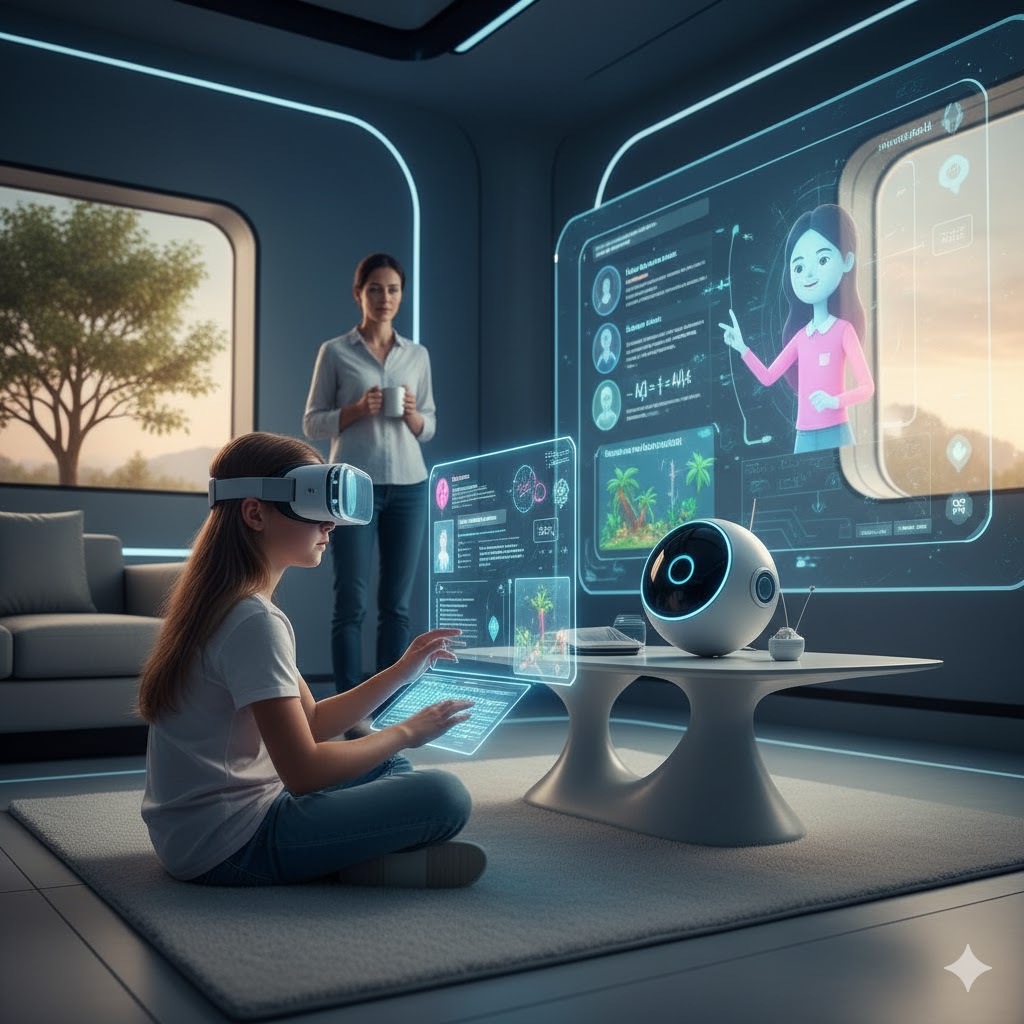
Research suggests that Gen Beta will experience a “synthetic childhood” where the boundaries between human and machine intelligence are continually blurred. Their Generation Beta technology usage begins virtually from the cradle. They will be raised with AI-powered toys, smart-home devices as companions, and automated assistants that manage everything from meal planning to learning schedules.
This is a stark contrast to previous generations. For Gen Beta, technology will not be a tool they pick up, but an ever-present, background facilitator. This hyper-digital environment results in highly personalized experiences—a great advantage—but parents (often Millennials and Gen Z) are already expressing concern about excessive screen time, limited physical exercise, and the resulting potential for minimal parent-child bonding. While they will possess superior multitasking abilities, some studies predict a corresponding shortening of attention spans due to the constant, rapid switching between digital stimuli.
The Critical Thinking Conundrum: The Risk of Cognitive Offloading
One of the most pressing concerns surrounding the AI impact on child development is the potential erosion of critical thinking. For previous generations, the struggle to find an answer, the process of trial-and-error, and the synthesis of disparate facts were the foundations of cognitive skill development.
For Gen Beta, AI promises to be the ultimate problem-solver, generating flawless reports, solving complex math problems, and providing instant, personalized information. While this access is efficient, it raises the specter of cognitive offloading.
If every challenge is “spoon-fed” a solution by an intelligent assistant, the opportunity for independent reasoning and deep-dive problem-solving is drastically reduced. Early evidence suggests a negative correlation between frequent reliance on AI tools and diminished critical thinking abilities. Furthermore, in the future workforce, the automation of entry-level tasks may prevent this generation from acquiring the crucial, on-the-job “tacit knowledge” that is built through hands-on struggle and expert interaction.

The AI Teacher vs. The Human Educator
The educational landscape will be revolutionized. Instead of a single human teacher catering to a classroom of thirty, Gen Beta will routinely interact with AI tutors and personalized learning platforms. These systems offer immense promise: they adapt content to individual learning styles, fill knowledge gaps instantly, and maximize learning efficiency.
However, a human teacher offers more than information transfer; they teach empathy, emotional regulation, patience, and social dynamics. If the primary educator becomes an algorithm, society must find new, intentional ways to foster the emotional intelligence and resilience that only complex, unpredictable human interaction can provide.
Navigating Reality: The Metaverse and Social Isolation
Gen Beta is projected to experience a world where immersive virtual and augmented realities (AR/VR) are commonplace. For them, virtual environments will not just supplement physical reality; they may coexist as equally valid parallel spaces for work, learning, and, most critically, socialization.
This omnipresent virtual world presents two major obstacles:
- Difficulty Navigating the Physical World: Prolonged immersion in highly controlled, tailored virtual environments risks a disconnect from and diminished appreciation for the natural, physical world. If their primary interactions occur through an avatar in a digital space, the ability to read subtle, non-verbal social cues in face-to-face interactions could suffer.
- Social Development Challenges: While the metaverse can improve social skills by offering a low-stakes environment to practice interaction, the over-dominance of screens may result in significant difficulties maintaining deep, meaningful relationships in real life. If Gen Beta finds themselves more comfortable communicating with friends across continents than interacting with the loved ones across the dinner table, the foundation of close social bonds, even with close family members, could be compromised.
Hope in the Hyper-Digital Age
While the challenges of safeguarding Generation Beta’s social development and preserving critical thinking skills are immense, the advantages of this new world are equally compelling.
Gen Beta will be exceptionally adaptable, globally connected, and equipped with the power of AI to tackle monumental challenges, such as climate change and global pandemics, with unprecedented speed and data-driven insights. Their personalized education will likely make them masters of focused, adaptive learning.
The key to their success lies not in preventing the future, but in guiding it. We must ensure that their education intentionally focuses on human-centric skills: emotional intelligence, collaboration, ethical reasoning, and critical engagement with AI. By proactively prioritizing real-world exploration and fostering strong familial and communal bonds, we can help the AI native generation leverage the power of technology without losing their essential humanity.
https://mccrindle.com.au/article/generation-beta-defined
https://www.weforum.org/stories/2025/02/generation-beta-and-the-global-economy




Leave a comment